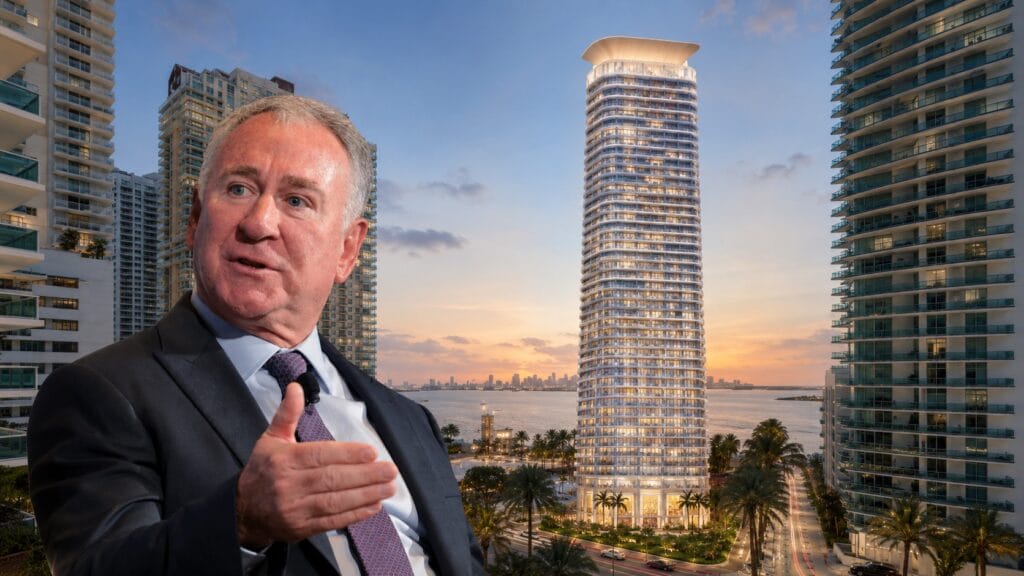
Brickell is changing again, and this time, the conversation is centered around the future of the Solaris tower.
According to the Miami New Times report on Griffin being confirmed as the buyer behind Brickell’s Solaris tower, Ken Griffin, the billionaire founder of Citadel, has been confirmed as the buyer behind Brickell’s Solaris tower. The report says the building is expected to be demolished as part of a larger development plan connected to Griffin’s growing presence in the area.
The Real Deal report on Griffin adding apartments and parking to his Brickell development plan also said Griffin revised his proposal for the 2.5-acre site at 1201 Brickell Bay Drive, adding a 300-unit apartment building and a 1,420-space parking garage near Citadel’s future headquarters. The project also includes a 54-story, 1.7 million-square-foot office tower planned for Citadel and Citadel Securities.
For many Brickell residents, the question is not just about one building. It is about what these changes could mean for the neighborhood over time.
Major investment can bring jobs, new businesses, improved infrastructure, restaurants, activity, and more attention to Brickell and Downtown Miami as one of the country’s most important urban business districts.
At the same time, residents may still have fair questions about traffic, density, construction, parking, walkability, public space, and how large-scale development affects the people who already live in the area.
Will 300 new apartments help meet housing demand? Will more than 1,400 parking spaces help serve the area, or add more cars to already busy streets? How should Brickell balance office space, residential growth, hospitality, and quality of life?
These are not simple questions, and there are different ways to look at them.
Growth is not automatically negative. Brickell’s rise has helped make Miami more competitive, more active, and more attractive to businesses, residents, and visitors. But as Brickell, Downtown Miami, Edgewater Miami, Midtown Miami, and Wynwood Miami continue to grow, planning becomes even more important.
The bigger conversation is about balance.
How does Miami continue attracting major investment while keeping its neighborhoods livable? How do we support development while also thinking about traffic, sidewalks, shade, green space, transit, waterfront access, and the day-to-day experience of residents?
Brickell has already become Miami’s financial center. Now, projects like this are making residents ask what the next chapter of the neighborhood should look like.
Do you think projects like this are helping shape Brickell’s future, or should residents have more say in how Miami’s urban core continues to grow?
Share this note
Join the conversation below.
Share your thoughts with the community.